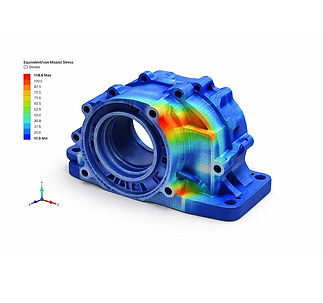
Analysis of a Gearbox Housing Under Operational Loads
A gearbox housing was evaluated to assess its structural performance under operational loading conditions. The component plays a critical role in supporting internal rotating elements while maintaining alignment and protecting internal mechanisms.
Finite element analysis was conducted to investigate stress distribution, identify critical regions, and ensure the housing met durability and performance requirements prior to manufacture.
Challenge
Gearbox housings are subject to a combination of loads, including bearing reactions, bolt preloads, and external forces transmitted through mounting points. These complex loading conditions can lead to stress concentrations, particularly around geometric features such as fillets, ribs, and bolt holes.
The objectives of the analysis were to:
-
Evaluate stress distribution throughout the housing
-
Identify critical high-stress regions
-
Assess structural integrity around mounting interfaces and openings
-
Ensure the design was suitable for operational loading conditions
Solution
A detailed finite element model of the housing was developed to accurately represent its geometry and loading conditions. Appropriate boundary conditions were applied to simulate real-world constraints, including mounting interfaces and load paths from internal components.
The analysis:
-
Applied representative loads from bearings and external supports
-
Evaluated von Mises stress distribution across the housing
-
Identified localised stress concentrations around rib intersections and bolt locations
-
Assessed load transfer through the structure and overall stiffness
The results highlighted elevated stress levels in regions where geometry transitions and load փոխանց paths intersected.
Outcome
The analysis provided valuable insight into the structural behaviour of the housing under realistic operating conditions.
Key outcomes included:
-
Identification of critical stress concentrations in high-load regions
-
Improved understanding of load transfer through ribs and mounting features
-
Validation of the overall structural integrity of the design
-
Recommendations for localised design improvements to enhance durability
Suggested refinements included optimising rib geometry, increasing local thickness in critical areas, and smoothing geometric transitions to reduce stress concentrations.
Testimonial
“The analysis gave us a clear understanding of how the housing performs under load and highlighted areas for improvement that were not immediately obvious. The insights were highly valuable in refining the design before production.”
— Senior Mechanical Engineer